Rotorua sits on top of one of the most active geothermal areas in the world, which means almost everywhere you go, something is bubbling, steaming, or quietly hissing away beneath your feet. And yes… there’s that sulphur smell you can’t miss!
The geothermal activity is one of the things that makes Rotorua unlike anywhere else in New Zealand. And if you’re visiting, it’s absolutely something you should make time for.
From a local point of view, each geothermal park in Rotorua offers something a little different. So instead of trying to do everything, here’s a simple breakdown to help you choose the right spot for you. From popular free spots through to more premium, high-end experiences.
Free geothermal spots in Rotorua
Lakefront geothermal walk (Sulphur Point)
Down by the lakefront, near Sulphur Point, you can experience some of the beauty of Rotorua and see geothermal activity for free.
As you walk along the lake side, you’ll notice:
Steam rising from the ground
Warm geothermal patches
That unmistakable sulphur smell drifting across the water
It’s a simple, open walk rather than a structured park, but that’s part of the appeal. You can take your time, wander at your own pace, and see how geothermal activity sits right alongside the lake. You can do the entire walk which is about 1 hour or just stroll for a bit and turn back.
You’ll also often spot birdlife here, which adds something a little different to the experience.
Best for: A relaxed geothermal walk without the crowds.
Right in the middle of town, Kuirau Park is Rotorua’s only public geothermal park.
You’ll find:
Bubbling mud pools
Steaming vents
Free hot footbaths
It’s a simpler, more low-key experience than the main geothermal parks, but still a good option and especially being free. You can wander at your own pace, see bubbling mud and steam vents, and take it all in without needing a ticket.
The mud bubbles constantly, the steam vents throw off serious heat, and the foot-baths are warm year-round.
Best for: A quick introduction to Rotorua’s geothermal environment, or an easy stop with kids.
Important: Stay on marked paths, the ground can be unstable around geothermal sites. Always be cautious and stay safe.
Geothermal experiences in Rotorua
If you’re looking for a classic geothermal experience in Rotorua, this is where most people land.
These parks have entry fees, but they’re well set up, easy to navigate, and give you a really good mix of geothermal features, without needing to commit to a full day.
Wai-O-Tapu is probably the most visually striking of the geothermal parks in Rotorua.
This is where you’ll find:
The Champagne Pool (bright orange edges, deep blue centre)
Artist’s Palette (multi-coloured thermal pools)
Devil’s Bath (that unreal green pool)
Some of the most active mud pools in the region
It’s also home to Lady Knox Geyser, which erupts daily at 10:15am (manually triggered).
The whole park feels colourful, varied, and a little surreal. It’s the one most people picture when they think of geothermal Rotorua.
Best for: Colour, variety, and those iconic “Rotorua” photos.
Te Puia offers a more rounded experience, combining geothermal activity with culture.
The main draw here is Pōhutu Geyser, the largest active geyser in the Southern Hemisphere. It erupts multiple times a day, sending water up to 30 metres into the air.
Alongside that, you’ll also see:
Active mud pools
Large silica terraces
Native wildlife (including kiwi)
Cultural performances and carving schools
A very impressive experience.
Best for: Geysers, cultural context, and a more complete experience in one place.
Whakarewarewa Living Māori Village
Whakarewarewa offers something a little different again.
This is a living village, where geothermal activity is part of everyday life, not just something to look at.
As you walk through, you’ll see:
Steaming vents and smaller mud pools
Natural cooking areas using geothermal heat
Homes and community spaces built around the landscape
It’s a more grounded, human experience compared to the other parks. Less about big features, more about understanding how people live alongside the geothermal lands.
Best for: Cultural insight and a more personal, lived-in experience.
Immersive geothermal experiences in Rotorua
Hell’s Gate is the most active and intense geothermal park in Rotorua.
This is where geothermal activity feels raw and powerful. The mud doesn’t just bubble, it spits, splatters, and boils. The ground steams, the pools are large, and you can feel the heat as you move through the park.
Alongside exploring the geothermal reserve, you can also experience:
Natural geothermal mud baths
Sulphur spa pools
A more hands-on way to engage with the landscape
It’s a more physical experience compared to the other parks, less about standing back, more about stepping into it.
Best for: A more intense, hands-on geothermal experience.
Taiao Adventures Steaming Cliffs Kayak Tour
This is our experience, and it’s a completely different way to explore Rotorua’s geothermal landscape.
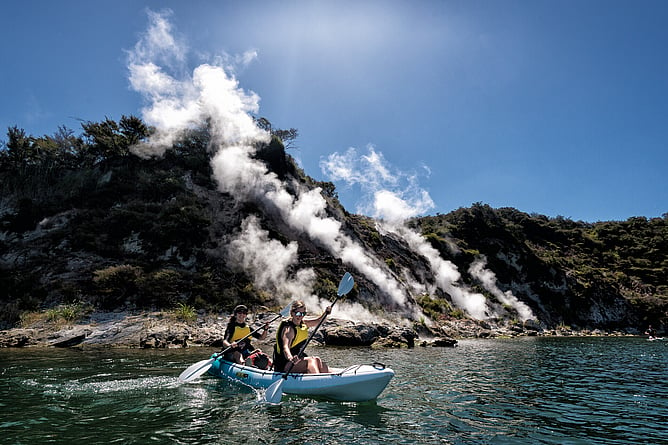
At Waimangu Volcanic Valley, visitors can explore the valley on foot, with the option to see Lake Rotomahana and the steaming cliffs by boat. Our tour offers a more immersive way to take it in, combining a private guided valley walk and kayak tour across the lake. We are proud to explore through this protected geothermal landscape, experiencing what feels like Middle-earth from a completely unique vantage point.
Along the way, you’ll move past:
Steaming cliffs rising straight from the water’s edge
Vibrant colours across the cliff faces and native bush
Geysers viewed directly from your kayak
Lake Rotomahana is not open to the public for independent access, which helps keep it calm, quiet, and undisturbed.
It’s a gentle, beginner-friendly paddle, done at a relaxed pace with time to stop and take it all in. A lakeside break with lunch is included, rounding out the tour.
Best for: A private, fully guided geothermal adventure exploring the steaming cliffs by kayak.
What you need to know before visiting Rotorua’s geothermal parks
The smell: Yes, Rotorua smells like sulphur (a bit like rotten eggs). You’ll notice it pretty quickly when you arrive, but most people adjust to it faster than they expect.
Stay on the paths: The ground around geothermal areas can be unstable and extremely hot. Stick to marked tracks and viewing platforms at all times, these landscapes are beautiful, but they need to be treated with respect.
Photography: Geothermal landscapes can actually be surprisingly hard to photograph well. Steam creates haze, lighting changes quickly, and the colours often look completely different in person. Take photos, absolutely, but don’t forget to put the phone away for a minute and just take it in.
Best time to visit: Early morning and late afternoon are usually the best times to visit. The light is softer, the colours stand out more, and the parks tend to feel quieter.
How many parks should you visit: One or two geothermal experiences is usually enough. They all showcase geothermal activity in different ways, so it’s more about choosing the experience that suits you best, whether that’s colour, culture, relaxation, or something more immersive.
A landscape you need to see to understand
Most places on earth don’t have mud that boils on its own, geysers erupting from the ground, or lakes and pools naturally coloured bright orange, green, and gold.
Rotorua’s geothermal activity is rare, dramatic, and incredibly alive, and seeing it up close gives you a much better sense of this place than any photo or video ever could.
If you’re visiting Rotorua, make time to experience at least one geothermal area properly. It’s one of the things that makes this region so unique, and something you’ll remember long after the steam clears.
Noho ora mai (stay well),
Taiao Adventures Team
Q: Do Rotorua’s geothermal parks smell really strong?
Yes it can. The sulphur smell is definitely noticeable when you first arrive (like rotten eggs), but most people adjust to it surprisingly quickly.
Q: Which geothermal park should I visit in Rotorua if I only have time for one?
If you want colour and variety: Wai-O-Tapu Thermal Wonderland
If you want geysers and culture: Te Puia
If you want something more immersive: Waimangu Volcanic Valley Steaming Cliffs Kayak Tour
If you want raw geothermal intensity: Hell's Gate Geothermal Park
Q: Are Rotorua’s geothermal parks suitable for kids?
Yes, most geothermal parks are family-friendly. Just keep a close eye on children, as paths can be narrow and geothermal areas can be extremely hot. Always stay cautious and safe around geothermal areas.
Q: Is Kuirau Park worth visiting?
Yes. Kuirau Park is free, central, and a great introduction to bubbling mud pools and steam vents. It’s more low-key than the paid parks, but still a genuine geothermal experience.
Q: What should I wear to Rotorua’s geothermal parks?
Comfortable walking shoes are a must. Breathable clothing and a light layer work well too, as geothermal areas can feel warm and steamy, while open sections can cool down quickly.
Q: How long do Rotorua’s geothermal parks take to visit?
Most parks take anywhere from 1–3 hours to explore properly, depending on the size of the park and how much time you want to spend there. Waimangu is larger and can easily take half a day if you explore the full valley.
Q: Can I visit multiple geothermal parks in one day in Rotorua?
You can, but most people find one or two geothermal experiences in a day is enough. Each park offers something different, but they all showcase geothermal activity, so visiting too many back-to-back can start to feel repetitive.
Q: Is Te Puia worth visiting if I am not interested in cultural performances?
Yes. Even without attending a cultural performance, Te Puia is still worth visiting for Pōhutu Geyser, the geothermal valley, silica terraces, and the Kiwi Conservation Centre.
Q: Can you touch the geothermal mud or water in Rotorua?
No. Geothermal mud and water can reach extremely high temperatures and cause serious burns. Even pools that look calm or shallow can be dangerously hot, so always stay on marked paths and keep a safe distance.