Glow worms - Arachnocampa luminosa - are larvae of a fungus gnat found only in Australia and New Zealand. And if you’re travelling Aotearoa’s North Island, you've got more options to find them than you probably realise.
Some glow worm sites are polished, well-established attractions with boats and guides. Others are wild, completely free caves where you’ll get muddy and wet. And some sit quietly in forests, gorges, or along lakeshores - places locals know well, but that don’t often make it onto standard itineraries.
I'm based in Rotorua, where I guide glow worm kayak tours most evenings, but I've also explored most of the other major spots across the North Island. Here's where to find them, and what makes each one different.
Free glow worm experiences
These spots cost nothing to enter, but require confidence, basic preparation, and a willingness to get muddy or wet. They’re great if you want something raw and unfiltered.
Waipu Caves (Northland)
About two and a half hours north of Auckland, Waipu Caves are completely free to enter. You park at a farmland entrance, walk a short track, and explore the cave on your own with a headlamp or torch.
The catch is there's no infrastructure. The cave floor is uneven, muddy, and wet. You're wading through water in places, and there are no guides or safety rails. If you're comfortable with that and don't mind getting dirty, it's a solid option. If you want any kind of structure, skip it.
Best for: Adventurous travellers who don't mind rough conditions and want a free glow worm experience.
Te Waihou Walkway (Waikato)
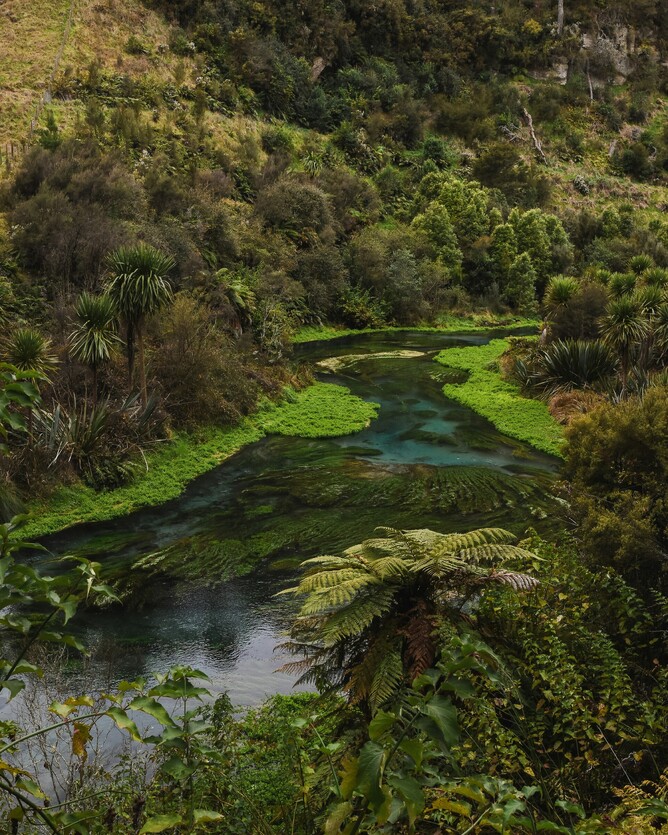
This isn't a cave - it's an easy walking trail near Putaruru (about 90 minutes south of Auckland) that follows a river and passes glow worm banks along the way. The walk is flat, well-maintained, and takes about 30-40 minutes one way.
You need to go at night or in the early evening to see the glow worms properly. Bring a torch for the walk, then turn it off when you reach the glow worm spots. They're scattered along the riverbank in sheltered, damp sections.
It's free, accessible, and good for families or anyone who doesn't want to go into caves but still wants to see glow worms.
Best for: Families or people who want an easy, free outdoor walk with glow worms.
Abbey Caves (Whangarei, Northland)
About two and a half hours north of Auckland, Abbey Caves are another free, self-guided option. There are three separate caves, all with glow worms, all accessible on your own with a torch.
The caves require more scrambling and climbing than Waipu - you're navigating tight spaces, squeezing through gaps, and getting wet and muddy. It's not for everyone, but if you're into caving and you want something more adventurous than a guided tour, this is it.
Bring a headlamp (not just a handheld torch), wear clothes you don't mind ruining, and go with at least one other person. The caves can be disorienting, and cell service is patchy.
Best for: Experienced adventurers who want a challenging, free glow worm experience.
Paid glow worm experiences
These options include guides, equipment, storytelling, and well-maintained infrastructure. They’re great if you want an easy, reliable, and safe glow worm experience.
Waitomo Caves (Waikato)
This is the most famous glow worm spot in New Zealand, and it's built for tourism with boat tours through underground rivers and professional guides who know the geology and the history.
The classic tour takes you through the caves on a boat while you drift under a ceiling covered in glow worms. It's impressive, well-organised, and works well for all ages and fitness levels. There are also adventure options like blackwater rafting if you want something more active.
The downside is it's popular, so you're sharing the experience with other groups. Book ahead, especially during summer and school holidays.
Best for: First-time visitors who want a polished, easy experience with no planning required, as long as you don’t mind the crowds and large tour groups.
Nikau Cave (Waikato)
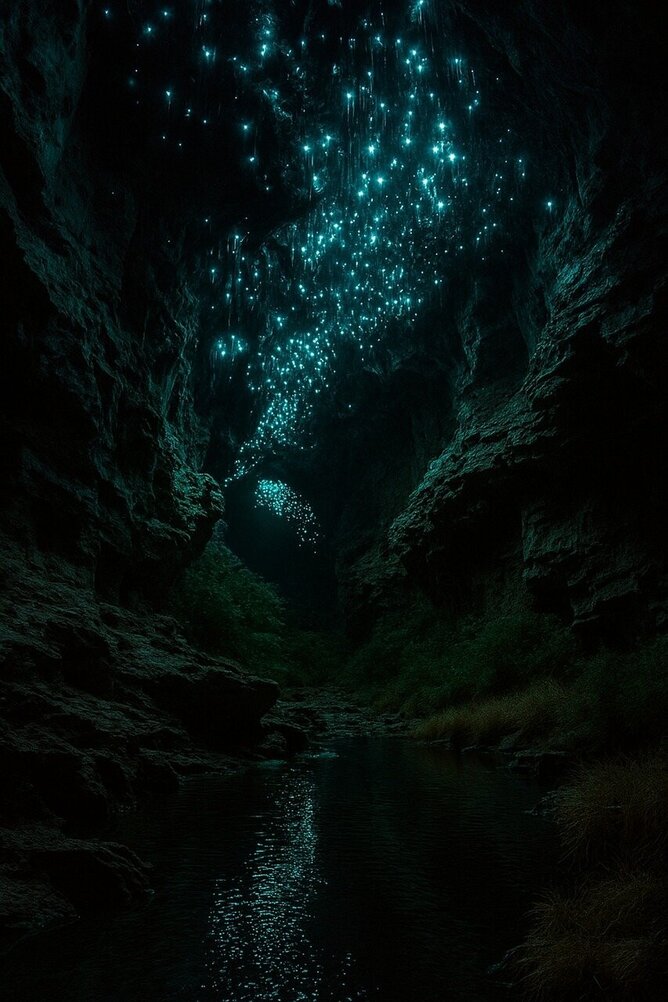
Ninety minutes south of Auckland near Port Waikato, Nikau Cave is a lesser-known spot that operates guided tours only. You walk through an underground stream - knee-deep in parts - past limestone formations and into chambers where glow worms cluster thick on the walls.
The groups are small, the guides are knowledgeable, and it’s a much more intimate experience than the big commercial tours. There’s also a café on-site that does good coffee and baking.
Best for: People who want a guided cave experience without the crowds.
Kawiti Caves (Bay of Islands, Northland)
About three hours north of Auckland near Kawakawa, Kawiti Caves are privately owned and operate guided tours. The caves are on the smaller side, but still impressive, with dense clusters of glow worms and interesting limestone formations.
The tours are run by the family who owns the land, and they include stories about the local history and the Māori connection to the caves. It's more personal than the big commercial operations.
The drive up to the Bay of Islands is scenic, so if you're already heading that direction, it's worth including. As a standalone destination, it's a bit far from Auckland.
Best for: People visiting the Bay of Islands who want a smaller, family-run glow worm experience.
Taiao Adventures glow worm kayak tours in Rotorua (Bay of Plenty)
Oh hey, these are the tours we run! And I promise you that this experience is different from any cave-based tours or experiences.
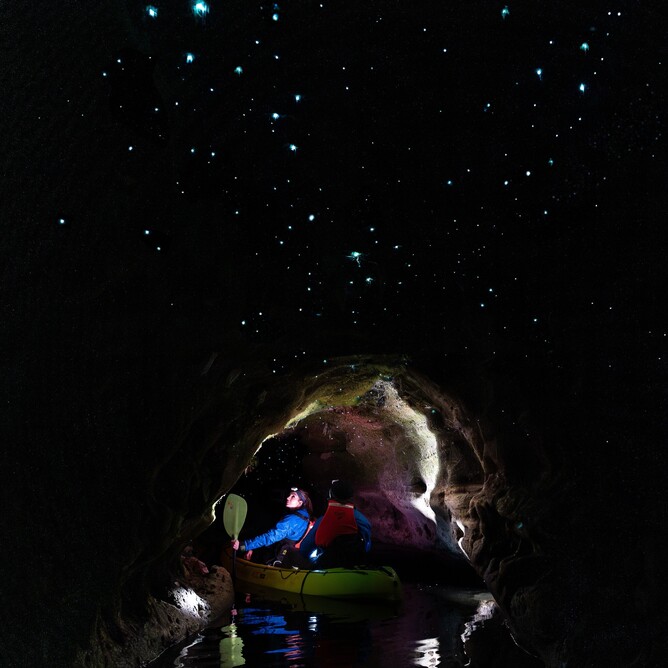
We take people out on the lake in kayaks at dusk to reach hidden caverns on the lakes edge. Once it's dark, we cut the headlamps, drift, and sit quietly in the small caves. The glow worms lighting up around you, on the cave walls, above you, and then reflecting from the water below. It’s a breathtaking experience!
Because you’re on the water rather than walking through a lit tunnel or sitting in a crowded boat, the atmosphere is naturally quiet, calm, and intimate. There’s room to take your time, whisper, and be still, which is why this tends to be a favourite for couples, friends celebrating something special, or anyone wanting an experience that’s a little more personal than a standard group tour.
Best for: People who want something unique experience you won’t find anywhere else!
The best glow worm experience for you
You don’t need to see every glow worm site to appreciate how special they are.
The setting definitely shapes the whole experience - a lit tour boat feels completely different from crouching through a muddy cave, and both feel different again from drifting across a lake in the dark, so pick the experience that matches how you want to feel, and go from there.
No matter where you end up, you’ll walk away having seen one of the most magical natural sights Aotearoa has to offer.
Noho ora mai (stay well),
Tom
Q: When is the best time to see glow worms in the North Island?
A: Glow worms are always visible after dark, but the darker the environment, the brighter they appear. Nighttime, with no moon or artificial light nearby, gives the clearest and most dramatic viewing.
Q: Do glow worms glow all year?
A: Yes - glow worms in New Zealand glow year-round. Their brightness can vary depending on humidity, temperature, and food availability, but there’s no specific “season” for seeing them.
Q: Can I take photos of glow worms?
A: We kindly ask you not to take photos, as they are very sensitive to light, and we want to protect them, and their environment. Plus, even with professional equipment, it’ quite hard to capture their faint natural glow! The best approach is simply to put your phone away and enjoy the experience.
Q: Do I need a guide to see glow worms in the North Island?
A: It depends on the location. Many glow-worm spots, like commercial caves and kayaking tours, require guides for safety and conservation reasons. Self-guided areas (such as certain free caves or forest tracks) can be explored independently, but you won’t get the same context, storytelling, or safety oversight that a guide provides.
Q: Is it safe to explore glow worm caves on my own?
A: Only at caves specifically designated as self-guided. Always bring a headlamp, wear sturdy footwear, and avoid entering water-filled sections, narrow sections, and unmarked or unofficial cave systems - they can be unstable and dangerous. And be sure to tell someone where you’re going and when you’ll be back.
Q: Why do glow worms glow?
A: Glow worms produce bioluminescence for a few different reasons. Their main purpose is to attract insects into the sticky silk threads they use for feeding - essentially using light as a lure. But they also glow to attract mates, and in some cases, to deter predators by signalling that they’re not an easy or worthwhile target. The brighter the glow, the hungrier or more active the glow worm usually is.
Q: Will my torch scare glow worms away?
A: Yes. Bright, direct light can cause glow worms to dim their glow or switch it off completely, which interrupts their feeding and mating behaviour. Strong light can also stress glow worms and, over time, disrupt the delicate environment they rely on. This is why guided tours ask visitors to turn off headlamps, keep torches pointed at the ground, and avoid sudden bright flashes. Protecting their darkness helps protect their wellbeing - and ensures everyone can see them at their brightest.
Q: Are all glow worm spots in the North Island suitable for kids?
A: Not necessarily. Family-friendly locations include guided cave tours, short forest walks, and glow-worm kayak tours with age limits (usually 5+). However, some free caves have uneven ground, deep water, or tight spaces that aren’t suitable for younger children. Choose a location based on your child’s comfort with darkness, quiet, and enclosed spaces.